
Wedding Lighting Design Guide for a Better Reception
The room can be beautifully decorated and still feel unfinished at sunset. That is where a thoughtful wedding lighting design guide becomes useful: lighting shapes what guests notice, how photos look, and whether your reception feels relaxed, romantic, energetic, or all three at the right times.
Lighting is not just an add-on for a dark ballroom. It helps define an outdoor tent after dusk, softens a large venue, brings attention to meaningful details, and supports the transitions that keep a celebration moving. The best approach is not to fill every corner with effects. It is to make purposeful choices that fit your venue, timeline, guest count, and budget.
Start With What Guests Need to See
Before choosing colors or specialty fixtures, consider how the event will unfold. Guests need enough light to arrive comfortably, find their seats, read menus, move safely between spaces, and enjoy dinner. Your photographer and videographer also need usable light during key moments, especially after sunset.
Then consider where you want attention to go. Your ceremony backdrop, sweetheart table, dance floor, cake, head table, and entrance often benefit from different lighting treatments. A lighting plan should guide the eye without making the room feel staged from every angle.
This is especially relevant in venues with mixed lighting conditions. A Colorado Springs celebration may begin with bright mountain sunlight and finish under a tent or in a dim reception hall. The shift from daylight to evening should feel intentional rather than sudden. Ask your event team what natural light is available, when the sun sets, and whether existing venue fixtures can be dimmed or turned off.
Wedding Lighting Design Guide: Build in Layers
A polished lighting design typically uses layers. Each layer has a job, and not every wedding needs every option. Starting with the essentials keeps the plan clear and makes it easier to invest where it will have the greatest impact.
Ambient lighting sets the overall mood
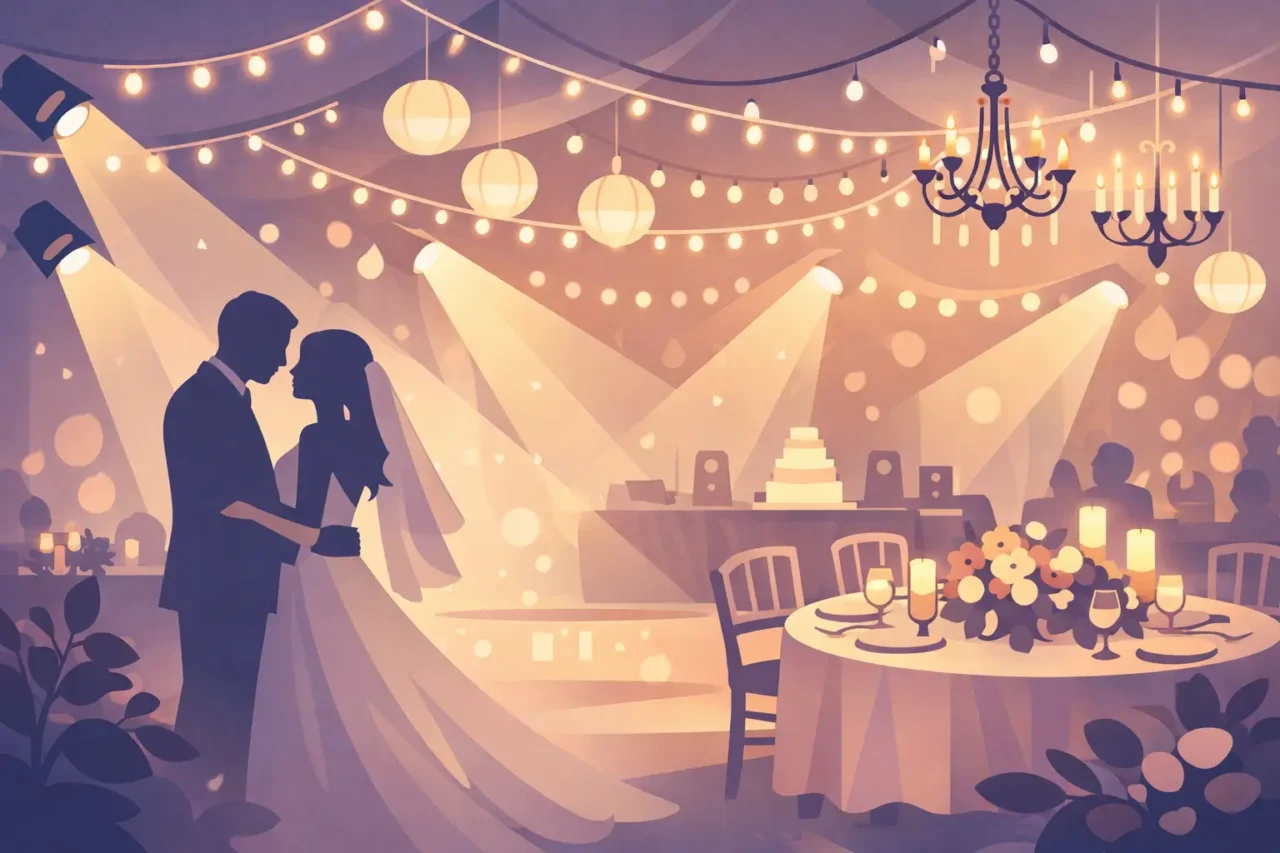
Ambient lighting is the foundation. It provides the soft, general illumination that makes a room feel warm and welcoming. In a ballroom, uplighting around the perimeter can add depth to plain walls and architectural features. In a tent, string lights, chandeliers, or fabric-wrapped fixtures can create a comfortable glow overhead.
Warm white light is a dependable choice for dinner and conversation because it flatters skin tones and works with nearly any wedding palette. Colored uplighting can be beautiful, but it should support the decor rather than overpower it. Deep blue, magenta, or green light on every wall can change how flowers, linens, and faces appear in photos.
For couples who want color, a practical approach is to use a soft neutral tone through dinner, then bring in richer colors for open dancing. That gives the reception two distinct moods without requiring a complete room transformation.
Accent lighting highlights the details you chose
Accent lighting directs attention to selected areas. It may be a pin spot on the cake, a gentle wash behind a ceremony arbor, or a focused light on the sweetheart table. These small decisions make carefully planned details visible without crowding the room with decor.
Pin spotting is particularly useful for centerpieces, cakes, and food displays in large or dim venues. Without it, beautiful floral arrangements can disappear into the room once the overhead lights are lowered. The trade-off is that too many focused lights can create visual clutter, so reserve them for details that matter most to you.
A monogram projection or custom pattern can also add personality to a dance floor or wall. It is most effective when it has breathing room. If the room already includes bold linens, a dramatic floral installation, and colorful uplighting, a monogram may be unnecessary.
Dance floor lighting changes the energy
Dinner lighting and dance lighting do not need to be the same. Once formalities are complete, intelligent dance floor lighting can make the celebration feel more active and invite guests to join in. The goal is energy, not distraction.
Work with your DJ and lighting provider on the timing. During first dances, a clean spotlight or soft wash keeps the focus on the couple. During open dancing, movement and color can build with the music. Strobe-style effects may be fun for some crowds, but they are not right for every guest list and can be uncomfortable for guests who are sensitive to flashing lights.
When entertainment and lighting are coordinated by one team, transitions tend to be smoother. The music can rise as the lights shift, rather than leaving someone to adjust the room after the dance floor has already opened.
Match the Lighting Plan to Your Venue
Your venue determines what is possible and what is worth paying for. A bright, modern ballroom may need warmth and dimension. A rustic barn may need safe pathway lighting, overhead coverage, and careful power planning. An outdoor venue may need a backup plan for wind, weather, and darkness.
Ask the venue these questions early: What lighting is already installed? Can it be dimmed? Where are the power outlets? Are candles, hanging fixtures, or open-flame decor allowed? Does the venue require insured professionals for overhead installations? These answers affect both design and cost.
Ceiling height also matters. Bistro lights can look inviting in a tent or courtyard, but a high ceiling may require professional rigging and additional labor. Similarly, uplighting is often a cost-effective way to transform a large room, while ceiling draping and suspended chandeliers can have a bigger price tag because installation is more involved.
Do not overlook practical areas. Light the path from parking to the entrance, the route to restrooms, and any outdoor lounge space guests will use after dark. Safety lighting can still look polished when it is integrated into the overall design.
Plan for Photos and Video, Not Just the Room
A reception that feels romantic in person can become difficult to photograph if it is too dark or lit with harsh, uneven color. Share your timeline with your photography, videography, DJ, and lighting teams so they know when major moments will happen.
Cake cutting, toasts, parent dances, grand entrances, and exits are common moments that benefit from planned lighting. A videographer may need a little more consistent light than guests realize. That does not mean your reception needs to look bright or clinical. It means the lighting team should create enough clean illumination for your creative team to capture the emotion.
Be cautious with strong colored lighting during formal photos and speeches. A purple room may look impressive from across the dance floor, but it can cast unexpected color on skin. Warm white or a neutral front light during toasts and dances often gives you more flattering results, with color still present around the room.
Make Budget Choices That Matter
Lighting can be tailored to nearly any wedding budget, so start by identifying the moments and spaces with the biggest return. For many couples, perimeter uplighting, dance floor lighting, and a clear plan for key photo moments create a noticeable difference without adding every available effect.
If your budget allows more, consider overhead lighting for a tent, draping with integrated illumination, custom projections, or enhanced focal-point lighting. If your venue is already visually strong, you may need less. A historic space with warm built-in fixtures, for example, might only need subtle enhancements.
Bundling services can also simplify decisions. At Complete Weddings + Events, lighting can be planned alongside DJ, photography, videography, and coordination needs, helping the people responsible for your event experience work from the same timeline and priorities.
Review the Plan Before Event Day
A final lighting conversation should happen after your floor plan and timeline are confirmed. Make sure your team knows where the head table, cake, dance floor, band or DJ setup, photo booth, and guest tables will be located. A lighting design that looked great on an early sketch may need adjustment once furniture placement changes.
Discuss the timeline in detail, including ceremony start time, sunset, dinner, toasts, first dance, open dancing, and exit. Decide whether colors should change throughout the night and who has the authority to make adjustments if the schedule shifts.
The right lighting does more than make a venue look good. It gives your guests a comfortable place to connect, gives your creative team the conditions to capture real moments, and lets each part of the celebration feel like it belongs to the next. Choose the effects you genuinely love, then let a well-organized plan carry the atmosphere from your first arrival to the final song.